

Studio-Quality Headshot in Seconds
Plus concerns from Davos and more publishers go to court
Welcome back!
Some time ago, I was searching for something on LinkedIn and stumbled onto the profile of one of my engineers. I was shocked.
From the top hat to the scowl (or whatever that facial expression was), he looked like a disgruntled magician.
I immediately set up a quick, informal meeting and asked him… why.
Why would you, in this day and age, have that as your LinkedIn profile picture? Is this from high school?
We had a good laugh about it, and I strongly recommended he change it, while admitting the truth: most of us don’t remember to update our photos until it’s inconvenient.
And when we finally do remember, we don’t have the time (or patience) to do it right then.
Still, profile pictures say something about the profile. The wrong picture might be sending the wrong message about you or your brand.
And I get it: we’re busy, and we barely have time to spend potentially hours (yes, hours, they creep up on you!) taking and retaking photos, then editing them until they look “professional enough.”
But these days, there’s a much faster way.
So, if there are profile pictures of you somewhere that are silently embarrassed on your behalf, while you keep hoping you’ll eventually find time to update them, you’ll find the Concept Corner topic below helpful.
Let’s dive in.
On deck:
◾ How to get a studio-quality headshot in 30 seconds
◾ Davos reality check
◾ More publishers go to court
◾ Quick Hits of 5 other AI News worth your attention
💡Concept Corner
Practical ideas to work faster and smarter.

Like I was saying, finding the time for a formal photo shoot can be a hassle. And if you want to do it in a studio, it can get expensive.
Still, your profile picture is often your first impression.
Whether it’s LinkedIn, a company website, or your personal brand, you want to look sharp.
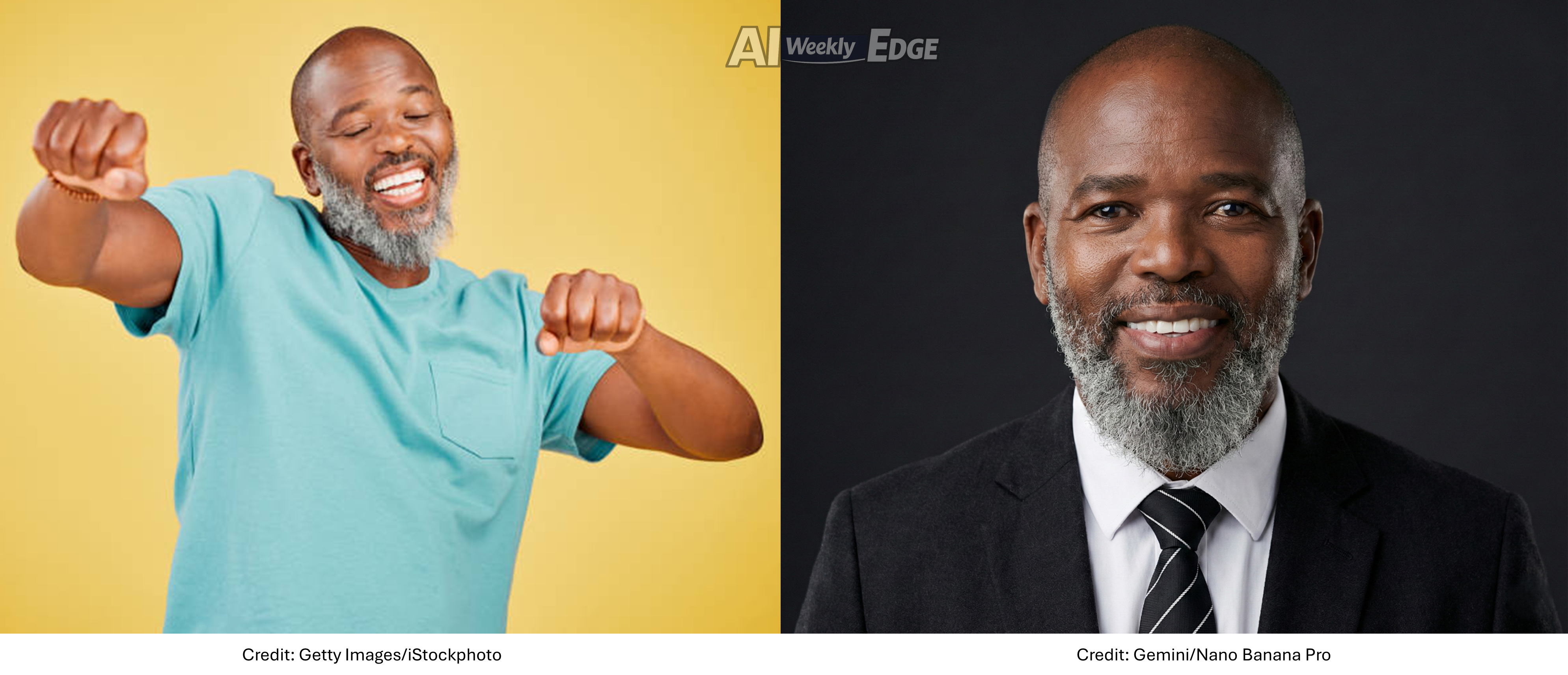
The good news: with Gemini, you can now turn a simple phone photo into a “studio-quality” portrait in seconds.
Step-by-Step Process:
Open Gemini and upload a clear, well-lit photo of yourself. It doesn’t need to be perfect, it could be a simple selfie against a plain wall.
If you have a specific style in mind, like a modern office or soft outdoor lighting, you can upload a reference image. This is optional. It helps Gemini understand the lighting and mood you’re aiming for.
Type in your prompt. Be specific: “Turn this into a professional headshot with a blurred office background.” You can also note your preferred aspect ratio.
Gemini will produce a professional-grade photo in seconds using Nano Banana Pro. If you aren’t happy with the first result, just ask for an edit, like “change my shirt to navy blue” or “make the background brighter.”
Below is a template of the prompt I used to create the image you see above, transforming the iStock image of “a happy man” into a professional head-shot.
Prompt template:
Using my uploaded photo, create a studio-quality headshot while preserving my identity exactly (same facial structure, proportions, age, and skin texture, no beautification or face swapping). Frame chest-up with natural headroom, camera-facing, relaxed confident [expression, smile], sharp focus on eyes. Outfit: [your attire]. Background: [color/style, e.g., deep charcoal studio, blurred books on a shelf, blurred office background with some small green indoor plants, etc.].
[(Option 1) If no reference image was provided, continue with this:] Lighting: soft diffused key light with gentle shadow definition.
[(Option 2) If a reference image was provided, continue with this:] Match the mood, lighting, and color grade of the reference image I provided, but keep my face unchanged.
📡Signal behind the buzz🔊
Decoding trending AI stories.
Davos Reality Check

🔊Buzz:
At Davos, AI leaders reignited the jobs debate. Google DeepMind’s Demis Hassabis and Anthropic’s Dario Amodei pointed to early signs that AI is squeezing junior roles like internships, entry-level coding, and other “starter” work.
📡Signal:
We’re witnessing the byproduct of task compression. In the software industry, for example, When AI helps a senior engineer draft code, write tests, and summarize requirements faster, there’s simply less low-stakes work to hand to a new junior hire.
Also, the conversation has been shifting from “wow” demos to “show me the ROI,” which pushes companies to deploy AI where it clearly removes costs, which is often the repetitive pieces of junior work.
🎯Impact:
For employers, the risk is an apprenticeship gap: if you stop hiring juniors now, you may not have seniors later.
For recent graduates in this space, treat “entry-level” as changing in expectations and responsibility, not disappearing. Learn to supervise AI outputs, validate results, and own end-to-end outcomes.
More Publishers Go To Court

🔊Buzz:
This week, publishers Hachette Book Group and Cengage Group asked a California federal court to let them join a lawsuit alleging Google copied copyrighted books and textbooks without permission to train its generative AI systems.
📡Signal:
Publishers are not being difficult.
A common misunderstanding is “models just learn like humans, so nothing was copied,” but training typically involves making large-scale copies so software can analyze patterns.
So, even if the end result is an AI model and not an eBook, using copyrighted work without permission is still a copyright infringement issue.
Google (and other labs facing similar claims) will argue versions of fair use and technical necessity, while publishers will argue the copying was massive, unlicensed, and produced a tool that can compete with their products in their markets.
🎯Impact:
If publishers win meaningful rulings or settlements, expect more paid licensing, tighter dataset documentation, and higher costs for frontier training.
If Google prevails, the signal to the market is that “train first, litigate later” remains viable.
Either way, creators and companies should assume the era of casual, untracked scraping is ending.
🍵Quick Hits of Other AI News
🧪 OpenAI says it’ll start testing ads on free/Go plans (free/Go plans only! People have been talking about this like it’s coming to all plans, which is untrue) in coming weeks, and brings $8/month ChatGPT Go to the U.S.
🛡️ OpenAI’s ChatGPT rolls out an age-prediction model to auto-apply teen safeguards, with selfie-based fixes if it guesses wrong.
🧠 Google’s Gemini “Personal Intelligence” push connects the assistant to your Google apps, so that it can pull real context specific to you.
🏦 U.K. lawmakers say the FCA and Bank of England should run “AI stress tests” for finance, to prevent AI-powered systems from inadvertently denying legitimate loan requests, enabling fraud, or triggering market chaos.
⚖️ Brazil’s prosecutors gave xAI 30 days to explain how Grok blocks deepfakes, after reports it was used to generate fake nude images of real people.
Thanks for reading, see you next week!
-Michael.