

Prompt Templates That Don’t Break
Plus don't marry a tool on the first date
🖊️Welcome back!
So here’s something I’ve learned in my entrepreneurial journey: never marry a tool on the first date.
When you find a tool you love and you’re ready to pay, start with the monthly plan.
No matter how much you "vibe" with a product or how convinced you are that it’s the missing piece of your workflow, start with the monthly plan.
That 30% annual discount looks like a steal, until four months later you realize you haven’t logged in for two.
There are exceptions, sure. But this mindset will save you a ton of money, especially as more “automate everything” tools flood the market.
Start monthly. Reevaluate in 4–5 months. If it’s still essential, then commit to an annual plan.
Alright, let’s dive in.
On deck:
◾ Prompt Templates That Don’t Break
◾ EU’s response to Grok Deepfakes
◾ Nvidia’s $2B CoreWeave Bet
◾ Quick Hits of 5 other AI News worth your attention
💡Concept Corner
Practical ideas to work faster and smarter.
A durable prompt template is one you can reuse across different AI models (ChatGPT, Gemini, Claude, etc.) without reworking it each time.
The strategy is to give the model a role, the goal, the inputs it will receive, the constraints it must obey, and what “done” looks like. It’s not about fancy wording, it’s about making your instructions portable.
Prompt template (example):
Act as a [role]. Your job is to produce a [deliverable] for [audience]. First, ask me for any missing inputs you need. Use only the information I provide. Constraints: [tone], [length], [format], [must-include], [must-avoid]. Quality bar: it should be clear enough that a busy person can act without a follow-up. Output exactly in this structure: [paste structure]. After the draft, give a 3-bullet ‘What I’d tighten next’ critique.
📡Signal behind the buzz🔊
Decoding trending AI stories.
EU’s Response To Grok Deepfakes
🔊Buzz:
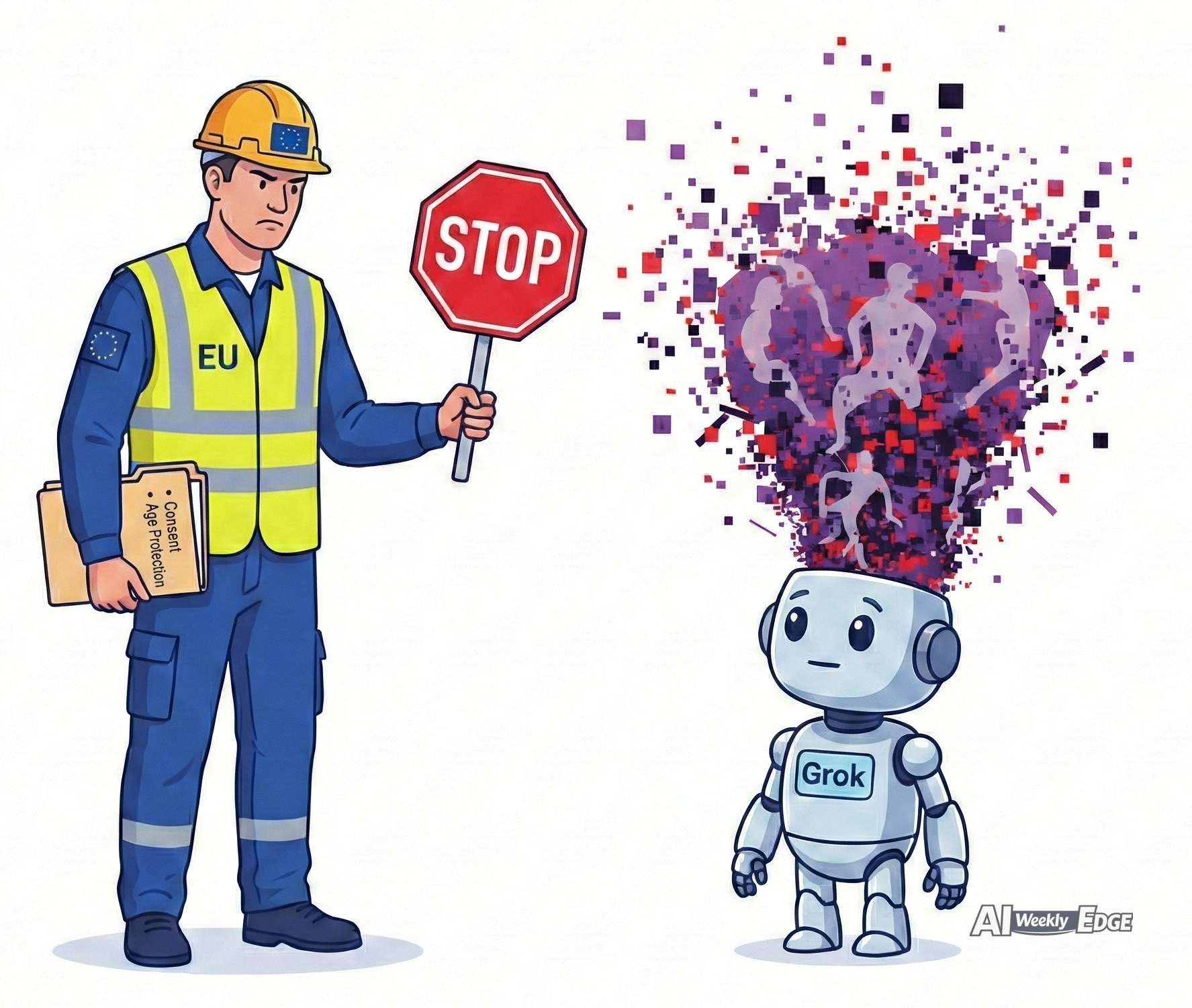
Grok (the chatbot inside X) is facing a global backlash after reports that users could generate sexualized “deepfake” images with simple prompts. The EU has opened a formal investigation, and the debate is swinging between free-speech arguments and “AI is out of control” rhetoric.
📡Signal:
The EU’s Digital Services Act (DSA) isn’t asking X to predict every bad prompt. It’s asking: did you assess the risks of deploying this feature, and did you build reasonable guardrails to reduce predictable harm, especially around children and nonconsensual sexual imagery?
That’s a product design question (what the tool can do by default). When image tools make abuse cheap and scalable, saying “we’ll remove violations” is damage control, not prevention.
🎯Impact:
This is a preview of where regulation is heading: more audits, faster safety updates, and real penalties when platforms launch powerful generative features without strong guardrails. Consent and age protections will no longer be afterthoughts.
Nvidia’s $2B CoreWeave Bet

🔊Buzz:
Nvidia just dropped another big check: a $2B investment in GPU-cloud provider CoreWeave. Some read it as confidence in the importance of that technology as a service; skeptics argue that Nvidia selling the chips and then backing the Cloud Service Providers that run them is just circular.
📡Signal:
The limiting factor for AI isn’t model ideas anymore. It’s power, land, cooling, and ready-to-use data centers to plug thousands of GPUs into.
CoreWeave specializes in building that fast. By taking a bigger stake and signing long-term capacity deals, Nvidia is making sure its hardware has a runway to operate at scale, while CoreWeave gets capital to secure real-world infrastructure.
🎯Impact:
Nvidia isn’t just selling the “picks and shovels” anymore. Financing the “mines” has become part of its strategy. With this stake in CoreWeave, Nvidia gets more than revenue: it gets more influence over the supply of raw processing power (chips + servers) as demand explodes.
🍵Quick Hits of Other AI News
🌦️ Nvidia released free-to-use “Earth-2” AI models that can turn weather data into much faster forecasts, cutting the need for expensive, slow supercomputer-style simulations.
📜 Anthropic published a new “Claude constitution,” basically Claude’s values + rulebook, and put it under a CC0 license (meaning anyone can reuse it freely, no permission needed).
🎓 Google is adding more Gemini-powered help to Google Classroom, like drafting assignments faster, summarizing class progress, and study tools (including practice SATs), designed so teachers don’t have to learn prompt engineering to use it optimally.
🧠 Microsoft introduced its own new AI chip, Maia 200, plus a developer toolkit that uses Triton (an open-source software), seemingly in a bid to reduce dependence on Nvidia and run more OpenAI-style workloads on Microsoft’s own Azure hardware.
💸 OpenAI is testing premium pricing for ChatGPT ads, around $60 per 1000 views, despite advertisers only getting basic performance stats (for now).
Thanks for reading, see you next week!
- Michael