

OpenAI💔Nvidia? + Moltbook Mania🤖
And how to go from rough idea to full deck in minutes.
Welcome back!
If your response is truly “Never,” lucky you! You’re basically royalty.
For the rest of us not born with that silver spoon, how much time do you spend making each PowerPoint? I bet it’s usually more than you’d like.
Today’s Concept Corner piece may not liberate you from the slides purgatory, but it will make you impervious to the heat.
Let’s dive in.
On deck:
◾ Rough Idea to Full Deck in Minutes
◾ Moltbook Mania
◾ OpenAI💔Nvidia?
◾ Quick Hits of other AI News worth your attention
💡Concept Corner
Practical ideas to work faster and smarter.
Rough Idea to Full Deck in Minutes
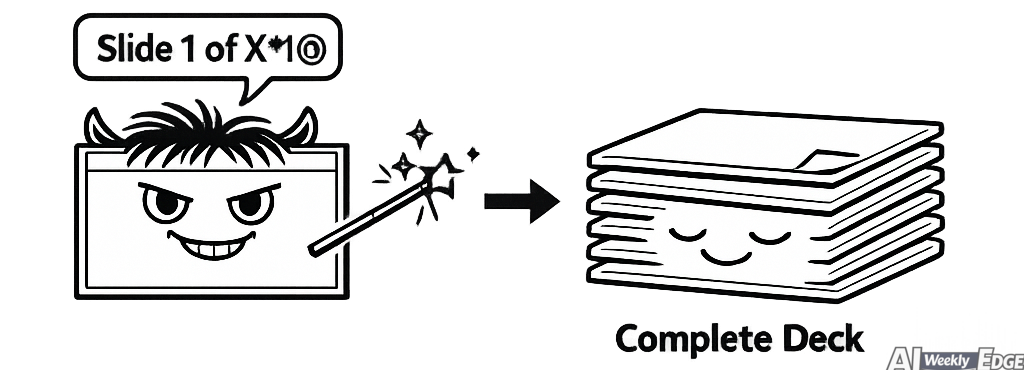
What it is:
AI tools like Gamma take a rough idea (notes, a prompt, a doc, etc.) and auto-generate a clean, structured slide deck with a theme, layouts, and visuals.
They do not replace thinking; they help us skip (or at least get a significant head start on) the tedious setup work: titles, slide order, spacing, design consistency, font choice, etc.
That way, you are able to focus on what matters: making sure your slides accurately capture your knowledge and desired flow.
Step-by-step Example (using Gamma)
Go to gamma.app and sign in.
Choose Presentation, then “Generate” if you just have a topic, or “Text to deck” if you’ve already scribbled some notes somewhere.
For Generate, type in your prompt (e.g., “A pitch for a sustainable pet food brand”). Gamma will draft an outline. Don’t skip this: review and edit the outline to ensure the flow makes sense and the overall deck feels cohesive.
Next, pick a theme. Whether you want “Corporate Professional” or “Neon Cyberpunk,” there’s a skin for every occasion. Also, don’t overthink it; you can always edit later.
Hit generate and watch the cards populate. Then edit as needed.
Export to PPT when you are happy with the results to make any final edits.
Summary
Gamma is not the only player (just one I’ve used before). Beautiful.ai is better for those who need strict brand consistency, while Dokie.ai is great for creating presentations that are a bit more interactive.
There’s also Canva’s Magic Design, Pitch, Plus AI, Kimi, Prezi, Presentations.ai, etc.
Regardless of which you choose, these tools eliminate the 'blank canvas' anxiety and save hours of manual formatting.
Remember to fact-check everything. AI is a confident liar, and can sometimes invent statistics that sound plausible but are purely fictional.
Also, you may not be able to get a 98% complete deck for every case. If you’re dealing with dense data or have strict brand rules, I strongly recommend that you generate a first draft, then finish manually.
📡Signal behind the buzz🔊
Decoding trending AI stories.
📍Moltbook Mania

🔊Buzz:
Moltbook went viral after screenshots of AI agents posting, joking, and even debating religion. It is being called the first real “AI agent internet,” and some believe it is the first real proof of sentience.
📡Signal:
The buzz has been a distraction (as is often the case). The real story is about the security risk this poses.
Cloud security firm Wiz says researchers could break into Moltbook, a vibe-coded platform, in minutes (they actually did, and reported it to the team). This is due to a basic database misconfiguration, exposing emails, private messages, and API tokens.
That matters because these agents are usually wired into tools (files, code, calendars, payments), so stolen tokens can become real-world access.
Oh, and the “🤭agents talking to each other” narrative is often humans seeding prompts, with automation amplifying the output. Not sentience.
🎯Impact:
The takeaway is security. Vibe-coding makes building apps easier than ever, but it also makes it easier to accidentally ship unsafe apps.
Companies building AI coding tools should make “secure by default” the standard: protect secrets, flag common misconfigurations, and guide users through a safer launch.
And if you’re using AI agents, treat them like a new teammate with access. Review their permissions: what can they read, change, or send. If a permission isn’t truly needed, remove it. Less access means less damage if something goes wrong.
📍OpenAI💔Nvidia?

🔊Buzz:
Headlines say OpenAI is “unhappy with Nvidia,” is shopping for alternative chips, and that a rumored mega-investment is currently on spaghetti legs. This has led to several hot takes on how OpenAI and Nvidia are "over.”
📡Signal:
Ignore the dramatic headlines; this is about Inference.
Think of building an AI like building a big library. Training the model is like moving all the heavy books and building the shelves: you’d need massive, raw power (GPUs) to do the heavy lifting once.
Inference (running the model for users) is like the librarian answering questions. You don’t need King Kong GPUs for that; you need speed, a great memory, and zero lag.
OpenAI wants faster, cheaper inference (especially for code-heavy use cases), so it’s testing a mix of suppliers, from AMD to specialist startups like Cerebras Systems.
They aren’t “leaving” Nvidia; they are just realizing that using a high-end GPU for a simple chat response is like using a Ferrari to deliver mail. It’s overkill.
🎯Impact:
The industry is moving toward a hybrid stack: GPUs for training, specialized accelerators for low-latency serving, and custom systems in between.
For AI product builders/creators, profit margins will soon depend less on which model is used and more on which chip is facilitating the response.
🍵Quick Hits of Other AI News
🌐 Google brought Gemini “auto browse” to Chrome. It can handle multi-step web chores (forms, planning, shopping) for U.S. Pro and Ultra subscribers, with confirmations for sensitive actions.
📊 Microsoft made “Agent Mode” in Excel generally available on desktop. Copilot can now do multi-step spreadsheet work, and you can choose between OpenAI or Anthropic models.
🏛️ The UK government is testing a new AI guide to help people find work, including giving personalized career advice.
🧪 OpenAI launched Prism, a free online workspace for writing scientific papers and collaborating on research, with GPT-5.2 built in.
💰 Meta is planning to spend more than $115 billion this year alone on AI infrastructure (data centers, compute, cloud capacity).
🧹 OpenAI announced it’s retiring older versions of ChatGPT (like GPT-5, 4o and 4.1) to move everyone onto their newest, smartest defaults.
Thanks for reading, see you next week!
-Michael.