

Execution Debt
Plus Whack-a-Blackwell & OpenAI partners with consulting companies
Welcome back!
As you know, this is the section where I get real about what’s on my mind. So for this week, here goes:
Sometimes I’m pumped to write this. Sometimes I’m not. This week, I was not.
And that’s because I find myself wondering whether I’m really connecting with people who are as excited about this subject as I am. I actually had to drag myself to my computer to start this today, and the only reason I did is because I believe in consistency.
But time is a scarce resource, and a deflationary one at that. With each passing day, it becomes more valuable. So it would be irresponsible not to make sure it is invested wisely. That includes pivoting when necessary, regardless of how I feel about it.
I have a few big goals for this year, and I am constantly thinking about strategy, execution, and whether I am being as efficient with my time as I need to be to hit my longer term targets.
Between working full time, building a software product on the side, reading daily, and working on a new book, time is tight. And that is before everything else life demands.
So the time I spend on this newsletter is very much a sacrifice, or a labor of love if you will. And I want to be sure it is worth it. That means making something people truly enjoy, something they return to each week and feel good about sharing.
If this is not connecting with you, or there are topics you wish I covered instead or in addition, please reply and let me know.
And if you love the content and think all the sections are great, let me know that too. Sometimes, when I am running low on energy, that is exactly the motivation I need.
Let’s dive in.
On deck:
◾ Execution Debt
◾ Whack-a-Blackwell
◾ Enterprise adoption is hard: OpenAI partners with consulting companies
◾ Quick Hits of other AI News worth your attention
💡Concept Corner
Practical ideas to work faster and smarter.
Execution Debt
What it is:
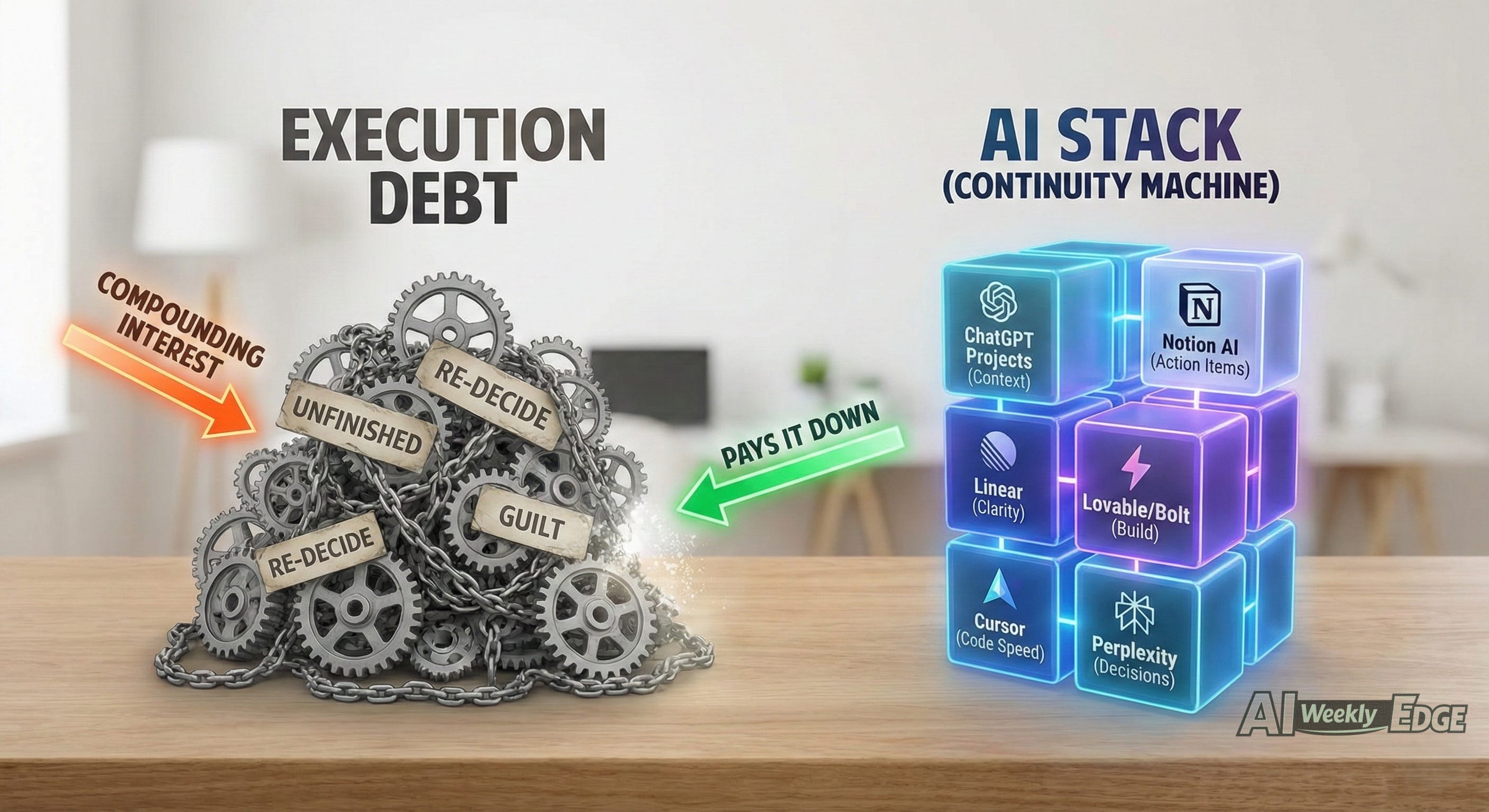
Execution debt is the interest you pay on unfinished work. It’s the constant mental reload, the re-deciding, the creeping complexity, and the subtle guilt that follows you into unrelated tasks.
The more ambitious you are, the easier it is to confuse motion with progress, and execution debt loves that confusion.
Example:
You are almost done building a new project that should ship soon, but you decide to re-tweak the copy first. Then rethink pricing.
Two days later, you return and burn 45 minutes just remembering where you left off, and because you don’t trust your past self’s decisions, you start re-editing instead of shipping. That is execution debt charging interest.
Sometimes these actions are warranted. But many times, they are simply a form of distraction or procrastination.
AI helps most when you use it to preserve momentum and march steadily toward execution, not to wade around in the quagmire of over-analysis and mistake that exertion for progress.
Helpful “Anti-Debt” AI Tools:
This is not an exhaustive list by any means, but it is a helpful starting point:
For persistent context, use ChatGPT Projects or Claude Projects. These act as self-contained workspaces with their own knowledge bases. They eliminate the “ramp-up tax” of re-explaining your project every time you sit down.
Use Notion AI to turn messy notes into action items and first drafts inside the doc where the work already lives. The standout is frictionless conversion from notes to next steps. You could also upload messy notes to ChatGPT or Gemini.
For rapid building, use Lovable or Bolt. These AI builders let you describe an app, see it, and iterate. Their real value is psychological: they quickly turn “I should build this” into a prototype, so you can iterate on something real instead of a mental model.
For coding speed, use Cursor. If you write code, this AI-first editor shrinks the gap between intent and implementation.
For research, use Perplexity or the research modes of ChatGPT or Gemini. These stand out because the answers are detailed and come with citations, so you can verify quickly and decide faster.
📡Signal behind the buzz🔊
Decoding trending AI stories.
📍Whack-a-Blackwell

🔊Buzz:
Reports say Chinese startup DeepSeek may have trained a model using Nvidia’s newest Blackwell chips, even though those chips are restricted from being sold to China.
Online reaction has been along the lines of “Export controls don’t work” and “The chip ban has failed.”
📡Signal:
The reality is more complicated. Global hardware supply chains are messy. Chips move through resellers, data centers, and partners. Enforcement is not a simple on-off switch.
U.S. officials are now focused not just on physical shipments, but on indirect access and even whether companies can hide technical traces of which chips they used.
At the same time, model “distillation” lets companies learn from the outputs of powerful systems without even owning the advanced hardware.
The whole thing is a long-term geopolitical chess match over compute.
🎯Impact:
AI infrastructure has become a pillar of national strategy, which means access to advanced chips now shapes economic power, military capability, and global influence.
When cutting-edge compute (the advanced chips) becomes scarce and strategic, the pressure to bend rules increases. That tension is the real story.
📍Enterprise adoption is hard: OpenAI partners with consulting companies

🔊Buzz:
OpenAI is expanding enterprise partnerships and pushing its agent platform (named Frontier) deeper into large organizations. Yesterday, they announced Frontier Alliances with BCG, McKinsey, Accenture, and Capgemini.
📡Signal:
OpenAI’s COO said that AI still has not truly penetrated core enterprise processes at scale.
Individuals can use AI, but companies run on shared context, messy tools, approvals, and accountability.
Frontier is meant to close that gap with shared context, onboarding, feedback, and clear permissions.
This led to the team up with consulting firms, “…betting that a more hands-on approach will help corporate clients move beyond pilot projects to full-scale AI deployments.”
🎯Impact:
The next phase of AI is not about smarter models. It is about integration. The winners will be those who operationalize AI at scale and responsibly.
🍵Quick Hits of Other AI News
🧩 Anthropic pushed Claude Cowork deeper into the office, adding private plugin marketplaces, new connectors (Gmail/Drive, DocuSign, WordPress), plus Excel to PowerPoint workflows in research preview.
🕵️ Anthropic says it caught industrial-scale Claude “distillation” attempts via 24,000 fake accounts and 16M chats, naming DeepSeek, Moonshot, and MiniMax.
🧠 Google rolled out Gemini 3.1 Pro, pitching it as a reasoning upgrade with higher scores on complex problem-solving benchmarks across evaluation tests.
🛡️ Nvidia teamed with cybersecurity companies, including Akamai, Palo Alto Networks, and Siemens, to bring GPU-accelerated, AI-driven threat detection and response to industrial control systems and critical infrastructure.
🎬 Amazon Ads unveiled Creative Agent, an agentic tool that can research, brainstorm, script, generate visuals and voiceovers, then help deliver finished ads using Amazon’s retail signals.
Thanks for reading, see you next week!
-Michael.
Thank you for your labor of love! It does not go unnoticed. While my love for AI/ technology is not grand, I do find the topic interesting and think it's good to be in the know since this is our future.
Your hard work is appreciated!